
Collection history
Iconator: a directory with a social life
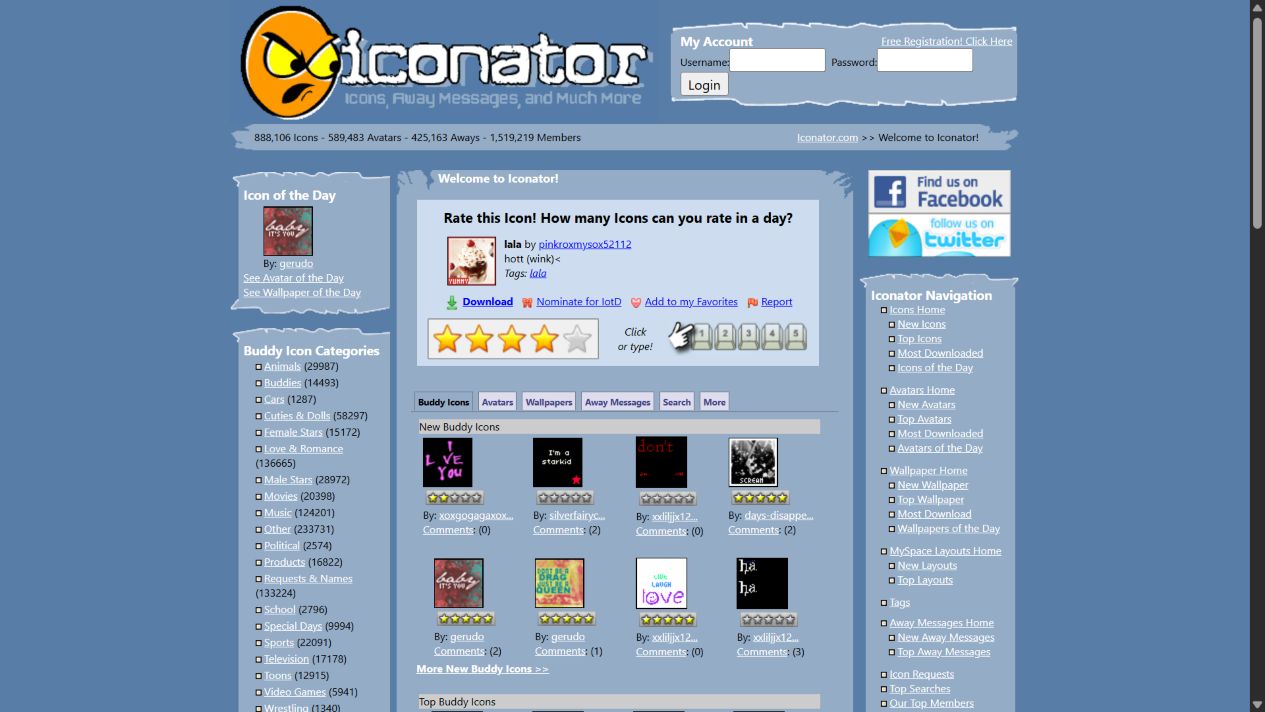
Read Iconator’s surviving interface as evidence of participation: contributor handles, ratings, comments, favorites, and icons of the day.
A picture with people around it
The surviving Iconator homepage connects images to contributor handles, comments, ratings, favorites, and an icon-of-the-day feature. Its navigation distinguishes buddy icons from avatars, wallpapers, and away messages. The interface preserves more than a list of downloadable files.
Our reading of those controls is that choosing an icon could also mean participating in a community: rating someone’s work, keeping a favorite, or returning to a contributor. A small graphic becomes an object of attention as well as a profile accessory.
What the surviving page can—and cannot—tell us
A displayed handle is a trace worth keeping, but it is not automatically proof of original authorship. Uploading, drawing, adapting, and reposting are different activities. A current legacy page also cannot establish when every feature first appeared. Dated captures and firsthand accounts are needed for that history.
The archive retains a March 2005 capture reference alongside the modern screenshot. Read each as evidence of its own observation date. The date of a webpage capture is not a creation date for all the images on it.
Following the objects
Start with Dollz, Anime, or Love to compare subjects that circulate across directories, then open the source records on individual icons. Those shelves span the archive; they are not presented as an Iconator-only inventory.
If you made icons or helped operate the site, a dated screenshot, saved page, or account of the workflow can fill gaps that the files cannot. The contribution desk accepts that context as well as images.